
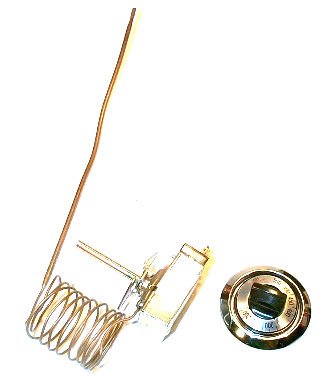
Robertshaw 5300-735 Thermostat
The Robertshaw 5300-735 is a heavy-duty pilot duty thermostat engineered for demanding commercial cooking and HVACR applications. Operating within a 175°F to 550°F temperature range, this SPST (Single Pole Single Throw) snap-acting control provides high-limit safety and precision for equipment like industrial ovens and deep fryers. This Uni-Kit model is designed for versatile field replacement, featuring a 60-inch capillary and a 3/16" x 11-5/8" nickel-plated sensing bulb to accommodate various mounting distances and cabinet depths. HVAC technicians appreciate the rugged construction and silver contacts that ensure sustained accuracy under high-vibration environment. With a pilot duty rating of 50VA at 120/277V AC, the commercial cooking control integrates seamlessly into existing safety circuits. The 4-way dial and universal mounting bracket enable flexible orientation while maintaining original indexing for direct replacement of Ranco G1 series and other high-temperature thermostats.
Key Benefits
- Universal Compatibility: Part of the Uni-Kit series, replacing multiple OEM standards with a flexible mounting bracket.
- Enhanced Durability: Equipped with silver contacts and heavy-duty terminals for reliable snap-acting operation in high-heat settings.
- Extended Reach: The 60-inch capillary provides the length needed for remote sensing in large-scale commercial appliances.
- Flexible Installation: Features a 4-way dial and bezel for mounting in any of four positions to match original equipment layouts.
Common Questions
- What is the difference between direct acting and pilot duty models? Pilot duty models like the 5300-735 are designed to control the circuit of a relay or contactor rather than the heating element directly, making them essential for high-load safety systems.
- Can this replace a shorter capillary thermostat? Yes, the 60-inch capillary can replace shorter lengths; however, ensuring the bulb is properly seated in the sensing well is critical for accurate temperature response.
- How do I handle a temperature discrepancy? Field calibration is possible via the adjustment screw on the stem, though technicians should ensure the equipment has cycled twice before comparing dial readings to a digital thermometer.
Disclaimer: While we strive for 100% accuracy, product data and specifications are subject to change. Please contact our team to confirm compatibility or technical details before purchasing.
QUESTIONS & ANSWERS
Have a Question?
Be the first to ask a question about this.