
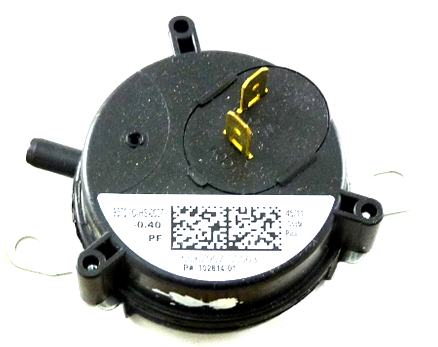
Armstrong Furnace R102614-01 Pressure Switch
As a veteran tech, you know that a failing Armstrong Furnace R102614-01 Pressure Switch is often the culprit behind persistent ignition lockouts and sequence-of-operation failures. This OEM replacement pressure switch is a direct cross for part 87H93 and is factory-calibrated to a -.40" WC set point. Built for precision in Armstrong and Allied furnace models, it features a standard SPST (Single Pole Single Throw) configuration and a 1/4" barb connection for a secure, airtight fit with your vacuum tubing. This safety device is critical for verifying proper inducer motor draft and ensuring that combustion gases are safely exhausted before the ignition sequence continues. Whether you are troubleshooting a furnace not igniting or dealing with a pressure switch stuck open error code, this component provides the exact differential pressure sensing required to restore reliable system performance. Its rugged construction is designed to handle the high-cycle demands of residential heating applications without the diaphragm drift common in universal aftermarket alternatives.
Key Benefits- Direct Cross Compatibility: Engineered as the professional-grade replacement for 87H93 and R45694-006 models.
- Precise Calibration: Fixed -.40" WC set point ensures the control board receives accurate airflow verification.
- Standardized Connections: Features a 1/4 inch barb and 2-wire SPST terminals for fast, drop-in installation.
- Safety Compliance: Prevents hazardous operation by monitoring the draft inducer vacuum and flue integrity.
How do I verify if the R102614-01 switch is faulty?
Use a manometer to check if the inducer is pulling at least -.40" WC and a multimeter to test for continuity across the SPST terminals when the vacuum is applied. If the draft is sufficient but the switch remains open, a replacement is necessary.
Can I use a universal pressure switch instead?
While universal kits exist, using this OEM Armstrong pressure switch ensures the trip point matches the original furnace design specifications exactly, preventing nuisance trips or unsafe combustion conditions.
What causes this switch to fail?
Common issues include a ruptured internal diaphragm, moisture buildup in the vacuum line, or integrated contact pitting over many heating cycles.
Disclaimer: While we strive for 100% accuracy, product data and specifications are subject to change. Please contact our team to confirm compatibility or technical details before purchasing.
QUESTIONS & ANSWERS
Have a Question?
Be the first to ask a question about this.