
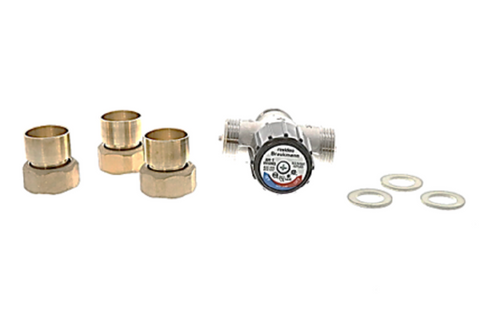
Resideo AM102C1070-US-1LF Valve
The Resideo AM102C1070-US-1LF is a lead-free thermostatic mixing valve designed for precision temperature control in high-flow domestic water systems and radiant floor heating applications. Constructed with a 1-inch union sweat connection, this professional-grade valve provides an adjustable temperature range of 70°F to 120°F, making it a critical component for preventing scalding while maximizing hot water heater capacity. This model is the direct field replacement for the legacy AM102C-US-1LF, engineered with a Teflon-coated internal shuttle to resist mineral buildup and ensure consistent performance in hard water conditions. The proportional valve design allows for a maximum flow rate of approximately 20 GPM, maintaining a stable discharge temperature even during fluctuating inlet pressures or temperatures. For contractors, the union connections facilitate fast installation and serviceability, while the locking nut ensures the setpoint remains secure, meeting stringent ASSE 1017 standards for point-of-source water distribution.
- Constant Temperature Control: Delivers precise mixing to maintain a consistent output, crucial for low-temperature radiant heating systems.
- Lead-Free Brass Construction: Compliance with all federal and state legislation for potable water applications.
- High Flow Performance: The CV rating of 3.9 ensures minimal pressure drop across the valve in high-demand residential or light commercial settings.
- Scald Protection: Engineered to automatically fail-safe to cold if the hot water supply is interrupted.
Commonly Asked Questions:
What is the maximum operating pressure for this valve?
The AM1 series mixing valve is rated for a maximum working pressure of 150 psi, though optimal performance is achieved when inlet pressures for hot and cold supplies are balanced.
Can this be used for point-of-use applications like a single sink?
While functionally capable, this 1" union sweat valve is optimized as a master mixing valve for whole-house distribution or large hydronic loops rather than individual point-of-use fixtures.
Is a check valve required with this installation?
Yes, to prevent thermal siphoning and cross-flow between the hot and cold lines, it is standard trade practice to install check valves on both inlets if they are not already integrated into the union tailpieces.
Disclaimer: While we strive for 100% accuracy, product data and specifications are subject to change. Please contact our team to confirm compatibility or technical details before purchasing.
QUESTIONS & ANSWERS
Have a Question?
Be the first to ask a question about this.