
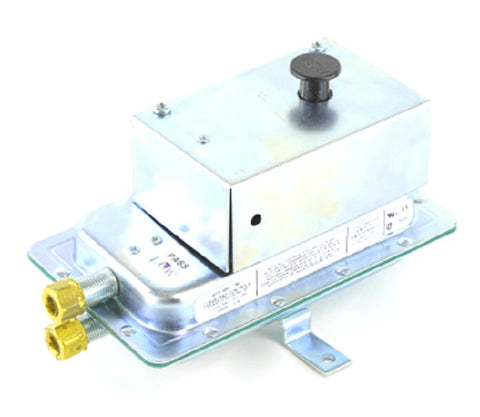
Cleveland Controls AFS-460-136 Switch
The Cleveland Controls AFS-460-136 is a professional-grade air pressure sensing switch designed for critical airflow proving applications in commercial HVAC and energy management systems. This field-adjustable unit features a DPDT (Double Pole Double Throw) relay configuration, providing versatile switching logic for 120V to 277VAC circuits. Engineered for precision, it monitors positive, negative, or differential pressure across a range of 0.40" ± 0.06" w.c. to 12.0" w.c., ensuring reliable performance in burner sequencing and fan status monitoring. The manual reset button requires technician intervention after actuation, protecting equipment from repetitive cycling during fault conditions. Constructed with a durable silicone diaphragm and a zinc-plated steel NEMA 1 enclosure, the AFS-460-136 is compatible with air and combustion by-products. The 1/4" compression fittings and 0.5" conduit connection simplify integration into existing HVAC control systems, making it a standard choice for contractors requiring a high-limit or safety-interlock pressure switch.
Key Benefits:- Broad Sensing Range: Field adjustable from 0.40" to 12.0" w.c. for precise system tuning.
- Safety Logic: Integrated manual reset ensures system faults are addressed before restart.
- High Compatibility: Reliable silicone diaphragm handles air and non-corrosive combustion gases.
- Versatile Wiring: DPDT contacts rated up to 8A at 250VAC allow for simultaneous control of multiple circuits.
- Robust Build: Plated metal housing with a protective guard for the set point adjustment and terminals.
How do I adjust the set point on the AFS-460-136?
Remove the metal guard and turn the adjusting screw. A digital manometer is recommended to verify the exact actuation point, as one full turn equals approximately 1.16" w.c.
Can this switch be used for differential pressure?
Yes, the Cleveland Controls AFS-460-136 features dual inlets—High (H) and Low (L)—allowing it to prove pressure drops across filters or coils.
What is the proper mounting orientation?
To maintain calfibration and accuracy at the lowest set points, the unit must be mounted with the diaphragm in a vertical plane.
Disclaimer: While we strive for 100% accuracy, product data and specifications are subject to change. Please contact our team to confirm compatibility or technical details before purchasing.
QUESTIONS & ANSWERS
Have a Question?
Be the first to ask a question about this.